A Global Literacy Crisis
10 Thinkers. 4 Levers. 1 Question

As a teacher of reluctant readers and writers, I would hardly expect my laments about the growing literacy crisis in America to gain much traction. People are scrolling, after all. And yet, I was dead wrong.
Last Thursday, I posted a long-form video on YouTube about how literacy is creating a class divide. By Saturday afternoon, it had been viewed over 100,000 times. As of this publishing, more than 250K views. YouTube. Literacy. Virality. These words hardly seem like they belong in the same sentence, but when people respond that thoroughly and that decisively, there’s a there there. I have created enough short-form, viral content to know when I’ve hit a nerve.
We have a problem. Not just in America. In Brazil. In the Philippines. In parts of Europe and the UK. Over one weekend, I read close to a thousand comments from Algeria to Australia about the growing complications of doomscrolling, the erosion of critical literacy, and the waning ability of children and adults to think, reason, and question.
For a moment I sat with the particular frustration of someone who sees a problem so overwhelming that they hardly know where or how to begin addressing it. I said to myself, “I would LOVE to get some of my favorite thinkers in a room and hash this out.”
Like the Avengers. Assemble a group of brilliant minds and Whiteboard our way towards something like a solution.
Imagine gathering Jonathan Haidt, The Freakomics guys, Adam Grant, Simon Sinek, bell hooks, Tristan Harris, Brené Brown, and a handful of creators who understand human behavior and culture. Give them a question, a whiteboard, and a few hours to wrestle with an idea.
How do we make thinking attractive again?
How do we create communities where curiosity is rewarded instead of certainty?
How do we build a culture that makes deep engagement more compelling than endless scrolling?
It reminded me of a question renowned educator, Ken Bain asked in his book, What the Best College Students Do. How do we get students to take the deep (rather than surface) approach to learning?
Of course, assembling a group like that would be a logistical and physical impossibility. Some of them are no longer with us.
And then it hit me. They may not be physically here, but their work is.
I could assemble them.
Not in a conference center.
Not on a stage.
But on paper.
So I did.
I spent an afternoon doing what scholars do: research. Armed with years of reading, teaching, and thinking alongside these thinkers, I convened a whiteboard session. I gave them a question. I let their ideas and tensions collide. I invited behavioral economists, organizational and social psychologists, cultural scholars, tech ethicists, TikTokers, journalists and myself to tackle the barriers and underlying issues that seem to be driving a global literacy crisis.
Easy right? Wrong.
The thinkers disagreed on almost everything except the diagnosis.
Whether they approached the problem through psychology, economics, technology, education, leadership, culture, or trauma, they kept circling the same four ideas:
• People need belonging before they can be curious.
• Attention is being actively competed for.
• Curiosity is as much an identity as it is a skill.
• Human behavior follows incentives.
What emerged wasn’t a movement towards literacy.
It was something larger.
A return to curiosity... that natural, innate form of human inquiry that gets decommissioned in grade school.
The question wasn’t how to get people to read more?
The question was, how do we create the conditions under which people want to think again?
Here’s what we had to say:
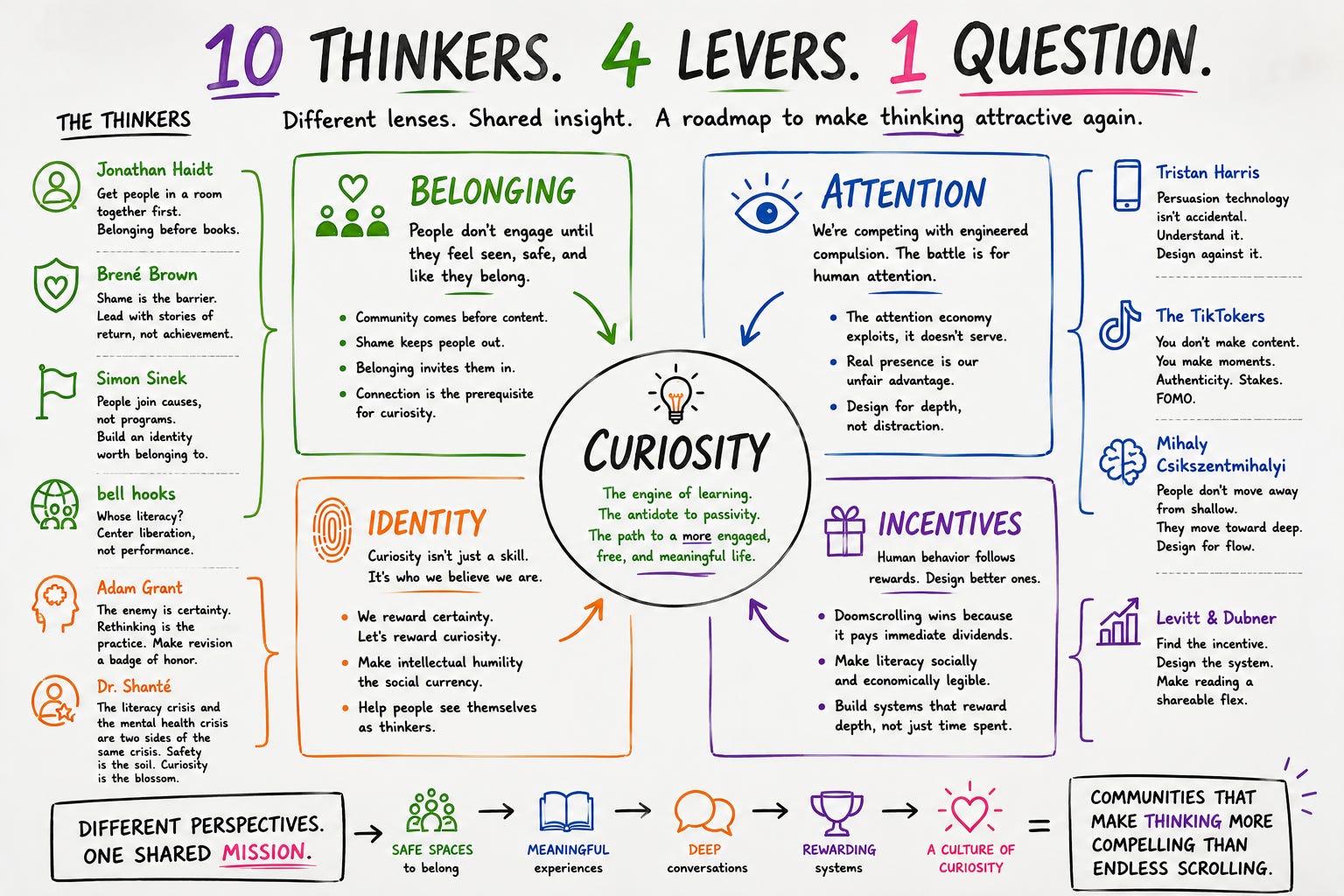
Jonathan Haidt says the problem isn’t that kids don’t want to read. It’s that we handed them a slot machine at age 11. The attention economy doesn’t compete with boredom; it exploits the social brain’s deepest need: to belong. His argument is before we build anything, we have to admit we are competing with engineered compulsion.
His recommendation: phone-free schools, cognitive recovery zones, and the radical proposition that belonging comes before books. Get people in a room together first. Connection is the genesis of community. Gather, then read.
Adam Grant would push back on the diagnosis before agreeing with the prescription. For him, the enemy isn’t TikTok. It’s certainty. We have built a culture that rewards confident assertion over curious inquiry. The salon model, where no single person holds the floor, where ideas get tested in real time against other ideas, and where changing your mind is not a sign of weakness works, works! It works because it creates structured permission to be wrong; to revise, to not know, to change your mind in public. That is countercultural right now. Make intellectual humility the social currency. Where’s its safe not to know or evolve without being canceled.
Steven Levitt and Stephen Dubner — the Freakonomics guys — would cut through all of it with one question: what’s the incentive? People aren’t failing to read because they’re lazy. They’re responding rationally to a system that rewards scrolling with status signals, social proof, and micro-dopamine hits every three seconds. A curiosity community has to compete on those terms. Leaderboards. Streaks. Reading as a shareable flex. Make literacy economically and socially legible. What’s in it for them? And then make it obvious and irresistible.
Simon Sinek would say all of that is infrastructure without a soul. Nobody joins a movement because it’s good for them. They join because they want to belong to something. The why has to be identity: we are the people who think deeply, who chose difficulty, who refused intellectual passivity. Without a clear, emotionally resonant why, you have a program. With it, you have a movement.
Brené Brown would slow everyone down and ask: why aren’t people already joining? Could it be shame? Shame around literacy runs deep, especially in communities where reading was never modeled or valued. Any movement that positions itself as intellectual risks becoming a performance of belonging rather than the real thing. The hero of this movement is not the person who reads eighty books a year. It is the person who picked up their first book in a decade. The entry point has to center return, not achievement.
Tristan Harris is the tech guy who helped build the machine. The infinite scroll, the variable reward schedule, the manipulation of dopamine — none of that is accidental. It is persuasion technology designed by the best behavioral scientists money could buy. His warning is direct: if you build a curiosity movement without understanding that this is an intentional manipulation, you will lose. But there is hope. There is one thing the platforms cannot manufacture: the feeling of being truly seen. That is the leverage point. Real presence. Real discourse. The thing a feed will never replicate.
bell hooks would address the elephant in the room: whose literacy are we talking about? A movement that centers canonical Western texts and middle-class salon culture will reproduce the same exclusions that made many communities distrust book culture in the first place. She would insist the movement begin where people already are, with the texts and experiences that already matter to them. Literacy in service of liberation, not performance. The salon belongs in the barbershop, the church basement, the barrio, the community center. Not just the small batch coffee shop with good lighting and a Substack account.
The TikTokers — TikTokers in and of themselves aren’t the problem. Don’t hate the player. Hate the game. I think successful creators would say: you don’t make content. You make moments. Moments have three ingredients: authenticity, stakes, and FOMO. You need the messy, real moment. The exmotion. The experience. The, “this was so good; you had to be there. And it has to look like it accidental rather than intentional. The moment it looks like marketing, it’s dead.
Mihaly Csikszentmihalyi — the psychologist who spent his life studying he “flow state” the experience of being lost in a reverie of intentional activity — reframed everything. His argument is that people don’t abandon shallow distractions. They move toward deeper ones. Flow is the state where challenge and skill meet, where time disappears and a person is fully alive inside an experience. Doomscrolling is the counterfeit of flow. It mimics engagement without producing it. You scroll for an hour and feel empty. But if you lose yourself in a real conversation or a demanding book you feel full, spent, tired, but in the best way.
His recommendation: design every salon, every gathering, every reading circle around the conditions for absorption. Not too easy. Not too hard. Exactly at the edge of what a person can do. Build for that and people will come back without needing to be asked.
And then there’s me. I did not convene this session as a neutral facilitator. I came with my own .02 cents.
What I keep returning to is this: the literacy crisis and the mental health crisis are two sides of the same crisis. People are not scrolling because they are lazy or incurious or lost. They are scrolling because they are trying to regulate. The phone is doing what a therapist, a community, and a sense of safety were supposed to do. And it is doing it poorly.
When we experience adversity (and there’s plenty to go around) we develop survival adaptations. If we stay in survival mode long enough, those adaptations become calcified. So instead of being our best and highest selves which requires curiosity, curiosity becomes a luxury that we can’t afford. Not knowing means being wrong. Being wrong means being exposed. And exposure, for a lot of us, is not safe. We are desperate for certainty. So we stick to the devil(s) we know.
A literacy movement that does not account for the emotional dimension of thinking will plateau at the already-converted. It will reach the people who were always going to read, always going to show up, always going to raise their hand. It will not reach the people who need it most.
The Tensions
Of course, put ten brilliant minds in a room and they’re not going to agree on everything. The tensions are real.
Levitt and Dubner would lean towards incentives, streaks and leaderboards. bell hooks would say that gamifying curiosity risks reproducing the same extractive logic we’re trying to dismantle; it turns a liberation practice into another system that rewards the already-resourced. Both of them are right.
Haidt and Harris are focused on structure: policy, phone lockers, legislative friction. Brown and Sinek are focused on soul: belonging, identity, the emotional anchors that pulls someone through the door in the first place. The movement needs both, in the right sequence. You cannot build identity in a person who doesn’t feel safe. You cannot create safety without structure. The order matters: belonging first, identity second, systems third.
And then Csikszentmihalyi is asking a different question entirely: If you pull people way from screens, what are you pulling them toward? If the alternative to doomscrolling isn’t genuinely absorbing, then no incentive system or identity movement will hold. The room has to be worth staying in.
Which brings us to me:
Don’t call it a reading group.
Don’t call it a book club.
Don’t call it a literacy initiative.
Call it what it is: a place where it is safe to not know.
Curiosity Communities need places where people can ask, learn, practice, and evolve without being canceled or ridiculed or diminished. They are an invitation to ease out of survival and into a safe place to be curious, to try on a new shoe, a different garment.
And the entry point is not a syllabus or a summer reading list.
It is a guide to expansion. I started the year asking six questions:
1) What rooms do I want to be in
2) What do I want to experience?
3) What connections would I like to make?
4) What conversations would I like to be having?
5) What tables do I want to sit at?
6) In what ways can I contribute to the change I’d like to see in the world?
More times than not, the answers to those questions will not lead to screens and scrolling. They will most likely lead to exploration and experience and showing up for your own life. That is the next step. Not a campaign. Not a conference. A door, held open, for anyone who is willing.
In community rather than isolation.
In inquiry rather than certainty.
And if that sounds idealistic, I would argue that we’ve already tried the alternative.
We’ve built communities around outrage.
Around algorithms.
Around consumption.
Why not build communities around curiosity?
The door is open.
Come find us.
Wholly, Dr. Shanté
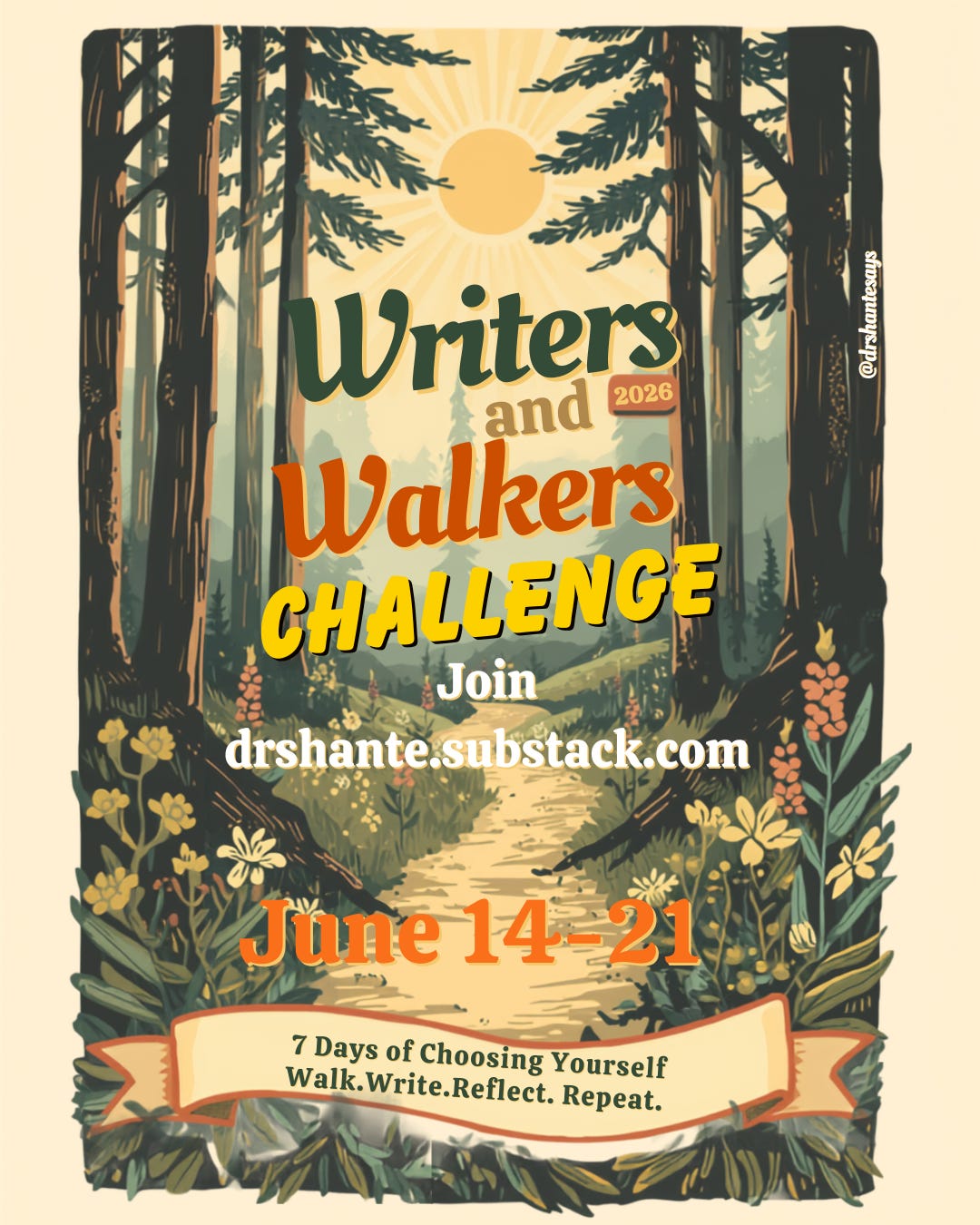
I know that was a long read. Thanks for thugging it out 😂 I would be remiss not to include an invitation to my annual walking challenge, Writers and Walkers. Its my fourth year inviting people to reset, reflect, and walk. We start THIS SUNDAY. You can learn more about it here:

7 days. 7 opportunities to clear your mind and ditch your phone. I hope you’ll join us. I’ll be posting the writing prompts this Sunday.
Cheers!
Yup. It was a long piece but well worth the read. If you see the way I was ready to put my hand up to join the conversation 😂 That’s exactly the kind of conversation I’m ready to lose sleep for (time difference). The thing that resonated with me most was about how to attract different people. When I worked in government, we had a little phrase “hard to reach communities”. We used to throw it around like confetti and pat ourselves on the back. Until someone from one of those communities said they weren’t hard to reach, we just didn’t want to change the way we engaged. That was a salutary statement. It’s about meeting people where they are. If someone’s entry point is a comic, then it’s a comic. Let’s get rid of the shame and snobbery around what people read.
Really great read! I love that you’re speaking to this and I love the idea of gathering thinkers together to puzzle it out— thanks for sharing what you’ve learned! I want the white board session for/from those of us who are wrestling with these big ideas but don’t yet have huge platforms and broad buy-in, as well!